Written by Megan Rouse, Communications Associate, UCLA Center for the Developing Adolescent
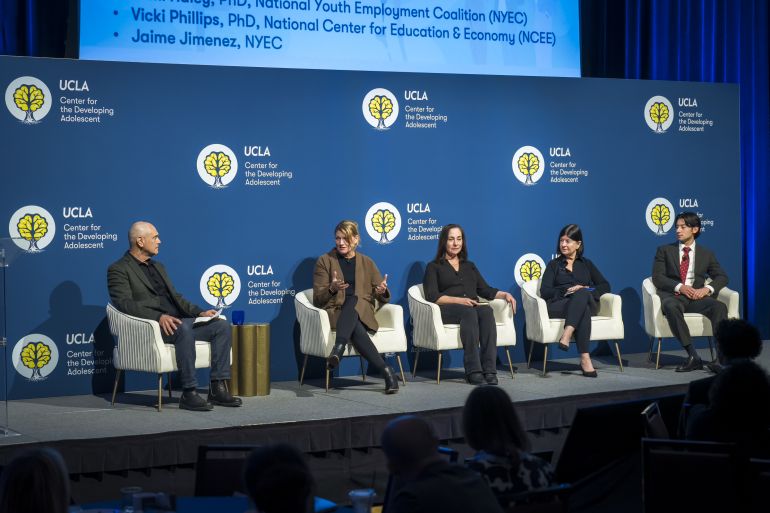
This blog post summarizes the first session of the 2026 Adolescent Brain Development Summit on Applying Developmental Science to Support Economic Opportunity. During this session, Candice Odgers, the Associate Dean and Chancellor’s Professor at UC Irvine; Mimi Haley, the executive director of the National Youth Employment Coalition; Vicki Phillips, the president and CEO of the National Center on Education and the Economy; and Jaime Jimenez, a youth policy and engagement coordinator at the National Youth Employment Coalition, spoke with moderator Ron Dahl, the founding director of the UCLA Center for the Developing Adolescent and a professor at UC Berkeley on a panel titled, “Navigating Uncertainty in the Future of Work for Young People.” Watch the full video on our YouTube.
Key Takeaways
Now is the time to design AI in a way that benefits young people and their futures. We need to start by centering young people in this discussion. We need to design AI with an understanding of adolescent development in order to reduce inequality and support the next generation of leaders to build adaptable skills for a rapidly changing world.
Adolescent brains are already primed to explore, connect, and contribute. We need to ensure they have the space, opportunities, and scaffolding to build their creativity, relationship skills, and the ability to build and sustain community. These are the kinds of “durable skills” they’ll need to succeed in their careers as well as the rest of their lives.
We need to provide young people with opportunities to co-design, lead, and offer solutions for issues affecting them. Allowing young people to contribute and collaborate can help build more effective systems and pathways that are informed by lived experiences and fresh perspectives.
The transition to adulthood has always involved uncertainty, as adolescents continue to form and refine their goals for who they want to become, how they want to contribute, and which pathways they’ll take to get there.
New and advancing technologies are amplifying this uncertainty, shifting the economic landscape in rapid and unpredictable ways, and leaving young people unsure about how to prepare for their future.
So, how do we help youth build the skills they need for meaningful careers and lives in this rapidly changing world?
The Opportunity of New Technologies for Young People
Since the public release of AI, there have been many questions about how this new technology may impact entry-level jobs, adolescents’ mental health, and the future of the world.
Professor Candice Odgers believes that we are at a pivotal moment in society, where we have an opportunity to design and implement AI in a way that supports adolescents’ development, well-being, and futures.
“As soon as we start centering technology, and start talking about AI’s effects on the teenage brain, we have lost,” said Candice. “If we center what we are trying to do with and for young people, we can start to have a conversation about what are the risks and what are the opportunities in that space.”
AI can be used as a tool to support young people’s learning and development and help support their key developmental needs to explore and connect. For example, AI can help young people explore new ideas, ventures, and solutions, and provide them with advanced tools for learning and discovery.
“AI does make an individual far more efficient, and it gives them the ability to iterate quickly. And so entrepreneurship is going to benefit from AI,” said Jamie Jimenez.
New technologies also offer new avenues to reach disconnected youth.
“In our digital age, we have more connectivity than ever before, and can reach people where they are using digital means,” said Mimi Haley. “Technology can play a role in helping us understand what the denominator is in youth experiencing disconnecting, and how we can get services to them.”
The Digital Divide
Candice cautioned that with new technology comes new risks of widening existing inequalities.
“The digital divide is real,” she said. “When a new technology comes onto the scene, the most likely thing that’s going to happen is it’s going to amplify inequalities unless we design for that.”
Young people growing up in high-income households tend to receive more scaffolding, support, and supervision around new technologies than young people in lower-resource settings. This extra support provides advantages for wealtheir youth that can exacerbate existing economic disparities.
But it is possible to build and design AI that bridges this digital divide instead of widening it.
Candice offered the example of the free SAT prep course developed with The Princeton Review, available through Gemini. Resources like this, if made available to all young people with proper scaffolding, could break down cost barriers for low-income students and create a world in which all young people have access to previously unattainable college entrance exam prep courses.
“We know ways we can center youth in design, that we can get companies to center youth in design, and design in ways that will reduce inequalities,” said Candice.
Skills Needed For An Evolving Future
“Another set of capacities that we think are increasingly important for humanity, amidst all of the technology, is relationship skills, connection, and increasing human-to-human interaction,” said Professor Ron Dahl.
In an uncertain future, more employers are looking to hire employees with these essential human skills, also called durable skills, which include creativity, adaptability, and communication. According to a 2025 report, 60 percent of employers say it’s more important for candidates to have these durable skills than it was five years ago.
These skills are not just important for young people’s future employment; they are also crucial for positive development. The ability to connect, sustain relationships, and build community is a predictor of better mental well-being in adulthood.
“As we look at how people are thinking about skill sets around the world, there are four big lenses that we work with states, systems, and countries to think about,” said Vicki Phillips.
The National Center on Education and the Economy (NCEE) describes four areas of skills necessary for adulthood: core academic and problem-solving skills, life-long learning, “contemporary skills” including creativity and collaboration, and community skills including connection and belonging. Adolescence is an important window to develop these durable skills, as brain and social development create new motivations to learn, explore, connect, and contribute.
“So those four categories, but thinking about them differently, and about how we create the solutions and the pathways for young people to acquire those skills,” said Vicki. “Thinking about that is as important as thinking more broadly about the skill set they need.”
These durable skills are not only beneficial for future well-being and job attainment, but they can also help young people connect with others in a way that provides them with social capital. According to a LinkedIn survey from 2020, 73 percent of people have been hired as a result of someone they know in a company.
Co-Designing the Future with Young People
One way to create effective programs and policies that help young people become successful adults? “Let youth lead,” said Mimi Haley.
“That works with these young people because if they’re setting their own rules, then they’re going to follow them and they’ll hold each other accountable,” she said.
Putting young people at the table to co-design programs and policies can be one way to create effective supports and systems that are informed by real experience and insights.
“One thing we have to do is move to a new normal about how we think about the involvement of young people in their own education and in our systems,” said Vicki. “I think we have to move to a place where we trust and where we are doing co-design with young people in all sorts of ways.”
Young people’s perspectives, experiences, and ideas can also help guide how we create policies around technology and young people.
“Young people are early enthusiastic adopters of all these technologies, and we have a lot of assumptions about what they can and want to do in these,” said Candice. “If we don’t pause for a second and try to understand what they are bringing to those spaces and what they can teach us, we’re going to fail again on the policy front because we will be designing policy that is just going to miss the mark in terms of what they really need.”
Conclusion
In a rapidly changing world, centering young people and their developmental needs is crucial. Adolescent brains are already primed to explore, connect, and contribute, exactly the foundations for the durable skills they’ll need to succeed in their careers as well as the rest of their lives. As adults, we need to work together with policymakers, companies, employers, and young people themselves to design and implement the connected pathways, systems, and technologies that set up young people for thriving futures.
Resources about preparing young people for the future:
In this fireside chat, our co-executive director, Adriana Galván, talks with the President and CEO of the Annie E. Casey Foundation, Lisa Lawson, about the ‘bridge’ that young people walk across in their transition to adulthood and how we can strengthen that bridge by providing support, scaffolding, and guidance.
In this blog post, we explore the importance of loving and supportive relationships with adults during adolescence, and discuss the significance and characteristics of natural mentors and developmental relationships.
_350_175_80_c1.jpg)