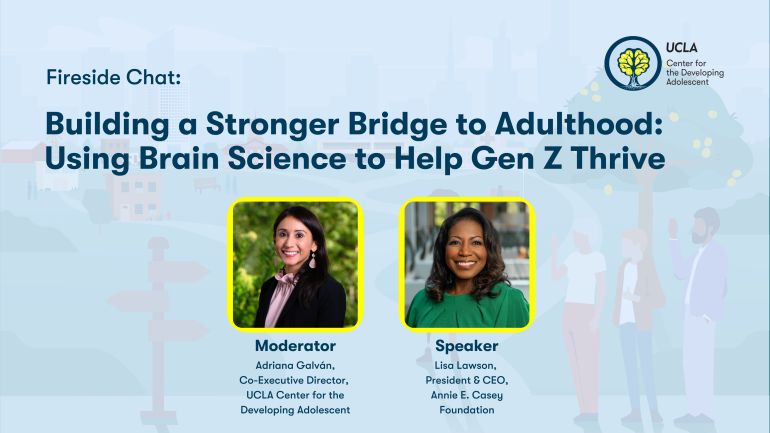
Fireside Chat: Building a Stronger Bridge to Adulthood—Using Brain Science to Help Gen Z Thrive
April 20, 2026
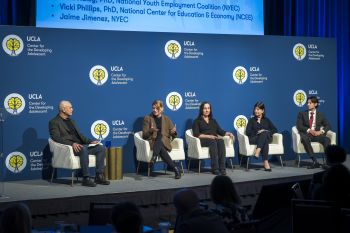
On March 19, the UCLA Center for the Developing Adolescent convened researchers, policymakers, practitioners, youth-serving organizations, funders, and young people for our 2026 Adolescent Brain Development Summit.
The Summit began with a keynote from Lisa Lawson, the president and CEO of the Annie E. Casey Foundation and author ofThrive: How the Science of the Adolescent Brain Helps Us Imagine a Better Future for All Children. Lisa talked about the ‘bridge’ that young people walk across in their transition to adulthood, and how we can strengthen that bridge by providing support, scaffolding, and guidance with encouragement from caring adults.
After the keynote, our co-executive director, Adriana Galván, joined Lisa on the stage and began a fireside chat session where they shared their thoughts on how we can support young people as they cross that bridge and enter the workforce and the rest of the adult world.
Find the full transcript from the fireside chat below, edited for brevity and clarity:
Adriana Galván Thank you, Lisa [for your keynote address]. That was perfect. I really can see that you’ve done a lot of reading on the adolescent brain, informed by the work of a lot of people in this room.
Lisa Lawson And by living through adolescence myself and raising an adolescent. And, you know, one of the most interesting things, as I’ve talked about in my book Thrive, is that people understand adolescence through the lens of being a parent.
Adriana Galván That’s right.
Lisa Lawson And the more we help parents understand what’s going on in adolescence, it really can inform how they lead and their other roles in life.
Adriana Galván We also have a lot of anecdotes about what it was like for us to be adolescents, right? And sometimes those don’t apply because maybe we didn’t know as much about the developmental science of adolescence at that time.
Lisa Lawson I’m a leader who didn’t have a hard journey to adulthood. I have a really wonderful childhood we’ve talked about.
Adriana Galván We both loved adolescence, and that’s why we’re here.
Lisa Lawson Yeah. I had a great time. And I now understand that it’s because I had all these guardrails and all these opportunities, and that my parents were fortunate enough to widen that pathway for me. So, I was in literally every program that could have been created to help me explore, work, and help me. I was a music kid, so I played the flute.I was a ballet dancer, and that was helped me build confidence and explore my talents. And so on.
Adriana Galván And they were cheering you on.
Lisa Lawson And they were cheering me on! I just really want all young people to have that kind of experience. Because I’m not here by mistake. I’m here by design. Right? And so I know how the things people put into you can help create amazing other young leaders.
Adriana Galván Yeah. You mentioned in your talk that the ‘bridge to adulthood’ has changed. How do you think adolescence has changed?
Lisa Lawson In so many ways. You know, I think sometimes adults are like, “Well, I made it across that bridge. Why do we need to do anything different?”
But, it’s very different today. You know, when you think about how the pandemic was horrible for all of us as adults, imagine being a young person and separated from your peers when that is such a developmentally important, relationship-building time. Their school was interrupted. They’re trying to learn through a screen. They didn’t have opportunities for those first-time jobs, or working as a lifeguard, or working at the mall. All of that was shut down.
Adriana Galván And just to connect is so important.
Lisa Lawson And just to connect! That was stunted. Then you think about, you know, AI—all of us are working as hard as we can to try to figure out how it’s going to change our jobs, it’s changing school for them. Yeah. They don’t know what job to even try for because they don’t know what might, you know, the jobs that they might have ten years from now don’t exist, and the jobs that they’re in school trying to learn the skills for now, you know, might not exist.
And the cost of living just goes up and up and up. We hear so much about, you know, how buying a home might be out of reach for the next generation. So, they’ll need a lot more flexible skills and a lot more agility if they’re going to navigate the world to come, which is going to very different.
You know, I majored in something and I could get a job in it and seamlessly go into that for the next 20 years. That is not going to be their experience, so they’re going to need a very different set of skills.
Adriana Galván And also, I’m sure they hear us talking about it. They hear our anxieties about their generation. And if we’re providing the anxiety without the solution or the flexible skills that they need, we’re not helping. We’re just planting the seed of fear.
Lisa Lawson Contributing to their anxiety, right, which they already have a lot of. I often say, you know, young people can hear us. I think we talk a lot of times assuming they don’t hear us talking negatively. I’ve never said the word teenager without somebody in the room going “urgh.” They see that! You know, they know that means that we don’t like them. Or that we don’t believe in them.
Adriana Galván And, yet, we also send another message that we want to be them, right? We try to adopt their language and their hair, and their fashion.
Lisa Lawson But then we demonize them. So yes, it is a very different bridge that they are crossing, and often they’re doing it while feeling like we’re not with them. That we’re not supporting them in the ways that they need.
Adriana Galván So how do we create more of that stability and these better on-ramps that they need?
Lisa Lawson You know, I think the first thing is basic needs. We’ve got to do more to strengthen the safety net for young people. There’s lots of work on adults and how much adults get access to benefits. But interestingly, there hasn’t been a lot of research done on young adults and how much they have access to benefits.
And it was really pretty low because often [young people] don’t think it applies to them. So we have these massive issues with food insecurity among college students. And a quarter of college students are parents, and they don’t understand that those benefits we often talk about, you know, to food or to housing, apply to them.
So, I know you’ve got one of our grantees here, the Student Basic Needs Coalition, that is trying to address that issue and using peer mentoring, using peer navigators to help young people, particularly who are students, get access to those benefits. That’s just one way, I think, we’ve got to tailor our support system and navigation to help young people get access to those basic needs.
You talked about what’s different—navigation is, I think, one of the most important things we’ve got to do, because I think it’s like the universal solver for so many things, whether it’s basic needs or education or workforce. The world is extraordinarily complex, and we’ve got to get more mentors and navigators equipped to help young people get through. And so peer navigation is just a great way to help them figure out, “How do I even apply for these benefits? Do they apply to me? How do I apply? How do I keep them?”
Adriana Galván And that’s responsive to what we know young people are really good at which is bonding with other people, forming connections, asking their peers for help.
Lisa Lawson And wanting purpose. And I think this is a leadership opportunity.
Adriana Galván Yeah, we’ll talk a little bit about that later. The program you mentioned, PAYA [Partnership to Advance Youth Apprenticeship],which I think you mentioned in Washington, I was really reflecting on how important it is that you bolster what we know about their inherent responsivity to rewards and feedback. Can you say more about that program?
Lisa Lawson That’s the opportunity passport work that we do around juvenile justice. It’s, you know, there’s just lots of conversation today about young people and crime. I wanted to level-set the audience that this is not every young person. There are 48 million young people we’re talking about, and they are not all, you know, creating negative communities for us.
But we’ve been doing juvenile justice work for over 25 years. And this science has been used to help address, you know, sentencing for young people so that we understand what is developmentally appropriate. But the incarceration part is the small part of what happens. The big part of what happens is probation.
And we realized a number of years ago, we got to do something to work on this probation situation because young people don’t do well with this list of rules that’s being given to them. And so that’s how we leaned on the science. And how can we create something that’s more aligned with the science? And I don’t think we even imagined it would be as successful as it was.
And the adults who work in the system enjoy it more, too, because they aren’t controlling young people.
Adriana Galván They are. They’re working with the receptive audience.
Lisa Lawson They’re taught to be coaches and to engage with young people in more positive ways. And they all say, I got into this work because I want to help young people. And if you give me the tools to help them better, I feel better about the job that I have. So it has really been transformative for the young people on probation and for the adults who are supporting them, who now feel like they’ve got the science, the understanding, and the mechanism to better help young people get on track.
Adriana Galván And the tools to lead with respect. We know that adolescents and the adolescent brain is really tuned into who’s showing them respect and disrespect. So what language can we use for signaling that to young people, that we respect them, in all of the programs that you spoke to?
Lisa Lawson Listening, it is the simplest thing we can do. Young people love to be heard. This is a time where they’re finding their voice. And in almost everything we do, we find a way to incorporate youth engagement in that work. In our juvenile justice work. We helped a number of facilities set up student councils for young people so that they could contribute to what would make this place safer? What would make this place help you dream?
What would make this place enable you to connect more? Young people aging out of foster care: in our apprenticeship work there’s always some council or advisory group of young people. And every single time they tell us something that we missed, they tell us something we didn’t think about. And they are extraordinarily creative. An example I didn’t give in my remarks is about a program called Soul Family. Too many young people age out of foster care, 20,000 young people a year age out of foster care without a permanent family.
And it’s because we don’t have a structure that meets the needs of all young people. The adoption might not work, guardianship might not work. So we gave the work to the young people. Well, what would you do?
And they said, we would create a new form of family where you, over the age of 16, get to pick unrelated adults who are in your life, who can become your legal family. And within two years that became law in Kansas.
Adriana Galván Wow, incredible.
Lisa Lawson Isn’t that fantastic? And now, I think 40 young people have a permanent family for life. And they got to pick a coach and a mentor and maybe a neighbor who couldn’t have otherwise been the family for them. And now it is being considered in Washington, DC, and in Oklahoma. So all because young people themselves said, well, thank you for asking. Here’s an idea.
Adriana Galván Yeah.
Lisa Lawson So listening. That is the biggest thing we can do to show them respect and to unleash the phenomenal creativity they have. I know you talk a lot about creativity that young people have, and we see every day.
Adriana Galván Well, that goes hand in hand with what you mentioned about risk taking, that they’re more comfortable with it. And being creative means putting yourself out on a limb, right? Individuals in our communities who are creative and artists, they’re always, testing their ideas, knowing that some may land, some may not. But that willingness to engage in the risk is something that our young people are inherently probably better able at doing than we are. Not probably, definitely better.
Lisa Lawson That’s the positive framing of risk taking. We often think it’s about driving too fast in your Buick Skyhawk on the highway, when it is really about being willing to just try different things. And to, and to put your ideas out there.
Adriana Galván Yeah. What are the other forms of risk-taking that we often don’t lift up?
Lisa Lawson Well, you know, even building relationships is a risk with other people to, to try to meet different people in different spaces and figure out whether or not they are folks that you could connect with. Work is a risk. You know, when you go to work, you’ve got to be open to learning new skills. You’ve go to be open to taking feedback. Sometimes criticism.
Adriana Galván And you’re often the youngest person in the room.
Lisa Lawson You’re often the youngest person.
Adriana Galván And ageism is real.
Lisa Lawson Oh, 100 percent. Yeah. It goes both ways.
But, you know, the ways that we grow throughout our lives is by taking the risk to try something else. You know, it’s a risk to be a tax lawyer and try to lead this foundation, you know? And I do think it’s during those times that young people get to see the rewards of risk, and because of that, we could become more willing to take risks as we get older as adults.
But that risk-taking is often beyond your family of origin. Yeah. And you know, the risks that you take, you know, in your family are very different from the risks you take in the workplace, where you don’t know these people and they don’t necessarily have any interest in you. That’s a big risk to do that in a space where you may or may not know how it will be received.
You know, I think this is sort of my advice to all of us as we have young people joining the workforce, Generation Z, to really sit and listen with them, give them guidance about and show them what are the norms in a particular workplace. Because it’s a scary transition for them as they join a workforce that they know isn’t always so keen on them.
Adriana Galván Yeah. What are some of the norms that may not be obvious to young people?
Lisa Lawson I admit, as a leader, I was sort of frustrated with all the questions that young people ask. They need to understand why. And that’s not a bad inclination. Like, aren’t you going to do a better job if you understand the why behind what’s going on? Many of us held our why inside when we were first joined in the workforce. They put theirs out. And, I respect that. Thank you for asking so that you have the right answer.
I also learned they skip hierarchy. You know, they will go to the president. “Well, I need to talk to you about that!” It’s because the world is flat for them. They grew up with social media. They can tweet the president of the United States. We didn’t have that when we were growing up. The bridge was different. They grew up without hierarchy in their lives. And so they think, “Well, I have a question. I need to go to the top. That’s the person who knows the answer.”
So, to help them understand, actually, the first person you should ask is your manager or your director. That’s not their first inclination. So, that’s just norm-setting to help them.
Adriana Galván And a very practical skill that would be helpful for everybody involved.
Lisa Lawson Right. But yeah, but you have to think about why they assume that. It’s just because their bridge is different than ours.
Adriana Galván So on the one hand they seem more bold socially. And on the other hand I always get questions about there’s you know, everybody’s anxious and whatever it is. So how does that square?
Lisa Lawson It’s all the truth. Both things are true. Can’t they be complex individuals just they way we’re complex individuals? I am an extrovert, but there are also times I don’t want to talk to people, you know?
Adriana Galván I’m the same way.
Lisa Lawson You know, let let them be fellow human beings with a range of emotions.
Adriana Galván Right. We put them in a box. We generalize.
Lisa Lawson We do. Nobody wants to be put in the box. I was talking to a group of women leaders, and I was like, you know the things we say about young people. Imagine in the 50s that this might have been the way people talked about women joining the workforce. They’re going to be too emotional. They’ve got all of these, you know, they care about purpose and other things.
Adriana Galván They’re going to ruin everything!
Lisa Lawson I’m a woman in the workplace. I wouldn’t want somebody stereotyping me as I joined the workplace or defining me in a certain way. All that to say that stereotypes are not a good thing for anybody at any age.
Adriana Galván Well, especially in this age group that spans so many years, right? You’re at initiatives are for 14 to 24. You know, we say 10 to 25. And that’s a long time, right?
Lisa Lawson That’s a long time. And, you know, the thing I write in the book is that we have the longest adolescence of any animal. Baby seals, it’s like maybe 10 weeks.
Adriana Galván Wombats are even shorter.
Lisa Lawson It takes us ten years to be human. And I think that’s really fascinating about what adolescence is doing. It’s actually giving us the capabilities—
Adriana Galván That extra time.
Lisa Lawson That extra time is what makes us human. Yeah.
Adriana Galván And the time isn’t just biological time, but it’s experience, right? For all of that time. It’s such a gift to have that much time to turn into the next stage of development, whatever your species is.
Lisa Lawson Although they’re different. At 18, yes, you are an adult and you can do certain things, but there’s still more time needed for us to fully bake. I joked that when I was pregnant, I signed up for some email, the Parent Center, and they would tell you, “Your baby is a peanut,” “Your baby is a mango,” so you could see what was happening developmentally.
But, no email showed up when my daughter turned 13! And so, you know, maybe we need to institute that. An e-mail saying, “Hey, your young person is this big, and here is what is happening in their brain.”
Adriana Galván Well, they couldn’t keep pace, right? My son, I mean, I’m short, but my son is so much taller than me now, and it happens seemingly overnight!
Lisa, thank you so much!
Lisa Lawson Thank you so much. It’s been really great.
Find all the videos from the 2026 Adolescent Brain Development Summit on Applying Developmental Science to Support Economic Opportunity here.
The transition to adulthood has always involved uncertainty, as adolescents continue to form and refine their goals for who they want to become, how they want to contribute, and which pathways they’ll take to get there. New and advancing technologies are amplifying this uncertainty, shifting the economic landscape in rapid and unpredictable ways, and leaving young people unsure about how to prepare for their future. So, how do we help youth build the skills they need for meaningful careers and lives in this rapidly changing world?
In this blog post, we explore the importance of loving and supportive relationships with adults during adolescence, and discuss the significance and characteristics of natural mentors and developmental relationships.
_350_175_80_c1.jpg)