Written by Megan Rouse, Communications Associate, UCLA Center for the Developing Adolescent
This blog post was written using information and quotes from our 2026 Love in Adolescence webinar on The Need for Love and Support from Caring Adults. Watch a recording of the event here.
During adolescence, we explore our identity, handle increased agency, and learn to contribute to the world around us. As we traverse the new opportunities and challenges of the adolescent years, our social worlds evolve and expand. Between the ages of 10 and 25, we forge new types of connections, find ourselves in more mature social situations, and may see our relationships evolve or shift to accommodate new obligations and needs.
Peers, friends, and romantic partners become increasingly important during adolescence. But some of the most impactful relationships we have during this period of development are with the caring adults in our lives.
The Importance of Caring Adults During the Adolescent Years
Research has shown that supportive relationships with adults, including parents, guardians, and mentors, are extremely important for positive development during adolescence.
“Relationships with parents and other caring adults, whether inside or outside of the family, remain among the most, if not the most, important and significant predictors of so many aspects of health and adjustment during adolescence,” says Andrew Fuligni, a professor of psychology at UCLA and co-executive director of the UCLA Center for the Developing Adolescent.
“It will even play a role in brain growth in fundamental regions of the brain that are going through significant changes during adolescence, such as those processing motivation, rewards, regulating emotions, and our understanding of the social world,” says Andrew.
Natural mentors
Only a small percentage of young people participate in traditional structured mentorship programs. But nearly three-quarters of youth report having a natural mentor, an adult outside of the immediate family who provides young people with support and guidance.
Natural mentors can be everyday caring adults that young people encounter, like teachers, coaches, counselors, extended family members, or members of a neighborhood or community.
These natural mentors are “much more common and can be profoundly influential,” says Kara Hirano, a senior research scientist at Search Institute who studies natural mentorship and developmental relationships.
“As a first-generation student…I am often the first in my family to experience many parts of adolescence living here in America,” says Odalis Hernandez, a high school senior and member of the CDA’s Youth Scientific Council on Adolescence. “Although my parents are extremely supportive, there are moments when they haven’t personally gone through many of the things I am experiencing.”
Natural mentors can help young people by offering guidance, emotional support, or scaffolding through complex systems that are hard to navigate without prior knowledge or experience. And this type of support and mentorship can have a profound impact on young people’s mental health and future economic success.
“Knowing that there are other adults I can turn to…knowing there are teachers and counselors that can provide me with the support I need has been a huge relief for me,” says Odalis.
Developmental relationships
But, how can these caring adults and natural mentors be more effective at supporting young people in their lives?
Search Institute defines developmental relationships as close connections through which young people discover who they are, cultivate abilities to shape their own lives, and learn how to engage with and contribute to the world around them.
“It really goes beyond that ‘caring’ piece, which is the foundation and is really critical,” says Kara. “There are these other components that make it a developmental relationship.”
According to research from Search Institute, youth who report having a strong developmental relationship also report more academic motivation and engagement, feelings of belonging, character strengths like responsibility and teamwork, and better social-emotional skills.
Search Institute’s Developmental Relationships Framework breaks down five characteristics that make a relationship with an adult impactful for young people:
Expressing care by being dependable, showing genuine warmth, and making young people feel a sense of value and belonging.
Challenging growth by encouraging young people to reflect on their achievements and setbacks, and pushing young people to reach their full potential.
Providing support by scaffolding young people through complex situations, systems, and challenges, and standing up for young people when they need it.
Sharing power by respecting young people’s opinions and giving them real ways to contribute and assert their agency.
Expanding possibilities by showing young people new perspectives, experiences, and places, and encouraging them to explore their identity and the world around them.
Find more information on Search Institute’s Developmental Relationships Framework here.
Odalis needed support during a time in her life when she felt uncertain about her purpose and the future. She found a mentor in the form of a distinguished medical professional, Dr. Ryan Osborne, who helped her explore whether medicine was the right career pathway for her.
“What stood out to me wasn’t his expertise, but the way he showed up as a mentor,” she explains. “He shared his personal experiences and challenges with medicine, presenting himself as a real person who has faced uncertainty and struggled rather than someone who had everything figured out.”
The support that Dr. Osborne provided, the respect he offered, and the opportunities to explore the pathway of a real medical professional helped Odalis figure out that she felt a true passion for this field, and helped solidify her goals and direction.
“Not only did Dr. Osborne help me find a career path I feel a passion for, he offered me his sincere support,” says Odalis. “Having a mentor like Dr. Osborne has shown me how powerful it is when adults simply meet you where you are and encourage you to turn curiosity and passion into care and action instead of trying to mold you into someone that you are not.”
Evolving Relationships and Continued Support
Relationships with adults may begin to shift as young people mature throughout adolescence. For example, young people might spend less time with caring adults in their lives.
“Relationships have to change; they just simply do,” said Andrew. “I think the idea of thinking of gradual allowances, of giving agency over time, over certain kinds of topics at certain points in their life.”
For example, during middle school, young people may start to make more of their own decisions about what clothes or hairstyles they wear. Older adolescents may take more agency over their lives by choosing whether to take a job, which job to take, or who they spend time with.
But, although these relationships might look different from how they did during childhood, it’s important to remember that this shift is normal and is actually a good thing!
During adolescence, young people grow, develop, and begin to require different things than they did during childhood. They build more and more agency throughout these years, explore the world around them, take risks, build decision-making skills, develop goals and identity, and look for a respected role among peers and adults.
Relationships with adults, “need to shift and evolve to accommodate and support our developing capacities as we move through the adolescent years,” says Andrew.
To support positive development, adults can work to understand and support the new opportunities, challenges, and needs of the adolescent years by talking with young people, providing opportunities for young people to meet key developmental needs, and using frameworks to evaluate their relationships, like the Developmental Relationships Framework.
And, adults should always remember that even though young people might spend less time with them, or if the relationship seems to shift as they get older, these relationships are still incredibly important.
“If there was one thing I would want people to take away from this conversation, it’s that supporting adolescents doesn’t necessarily mean preventing failure,” concludes Odalis. “It means creating environments where it’s safe to try and mess up and grow up, knowing that there are caring adults out there who are going to be our support system along the way.”
Key Takeaways
Relationships with supportive and caring adults during adolescence can bolster mental health, enhance overall well-being, help us create a healthy sense of identity, increase our self-esteem, and even predict the success of relationships in adulthood.
Natural mentors are defined as everyday adults who provide young people with support and guidance. These natural mentors can be teachers, coaches, counselors, extended family members, or members of the neighborhood or community.
According to Search Institute, adults can create developmental relationships with adolescents by expressing care, challenging growth, providing support, sharing power, and expanding possibilities.
As young people move from childhood into adolescence, their relationships with the adults in their lives need to shift and evolve to accommodate and support their developing capacities and increasing need for agency.
Watch the full Love in Adolescence webinar:
Find additional resources related to the importance of caring adults during adolescence:
The transition to adulthood has always involved uncertainty, as adolescents continue to form and refine their goals for who they want to become, how they want to contribute, and which pathways they’ll take to get there. New and advancing technologies are amplifying this uncertainty, shifting the economic landscape in rapid and unpredictable ways, and leaving young people unsure about how to prepare for their future. So, how do we help youth build the skills they need for meaningful careers and lives in this rapidly changing world?
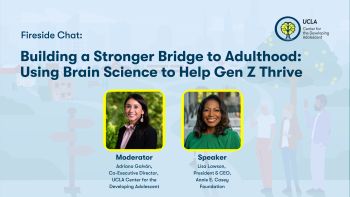
In this fireside chat, our co-executive director, Adriana Galván, talks with the President and CEO of the Annie E. Casey Foundation, Lisa Lawson, about the ‘bridge’ that young people walk across in their transition to adulthood and how we can strengthen that bridge by providing support, scaffolding, and guidance.

_770_385_80_c1.jpg)