Written by Brynn Santos, Zero Carranza, Genesis Paxtor, Natnael Gezaw, and Sofia Zianes
This post was written by high school students from the UCLA Summer Research Boot Camp in Adolescent Development led by UCLA professor of education Sandra Graham and UCLA professor of psychology and CDA’s co-executive director Andrew Fuligni. This boot camp was facilitated by graduate students Ava Trimble, Jasmine Hernandez, and Clare McCann and was supported by the UCLA Center for the Developing Adolescent.
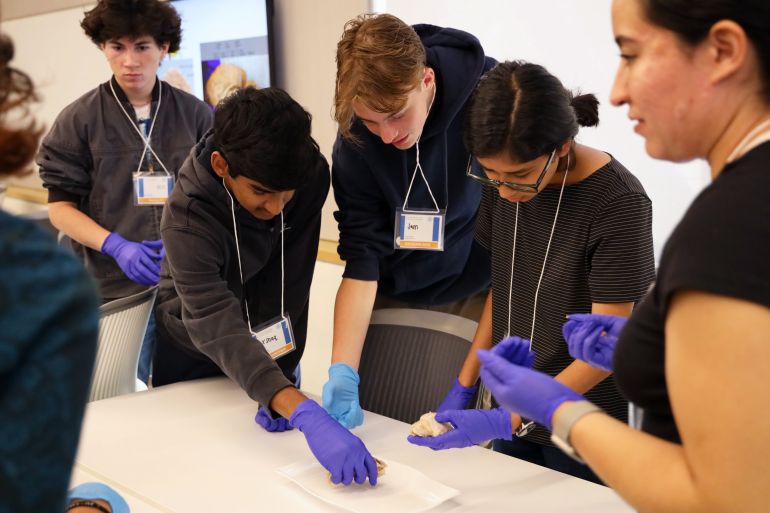
Adolescence is a period of remarkable change—emotionally, socially, biologically, and cognitively. This summer, we had the privilege of exploring these changes throughout the 2025 UCLA Summer Research Boot Camp in Adolescent Development. Over the course of two weeks, we learned how researchers study and ask questions about adolescent development, from how sleep impacts brain function to how friendships and school environments influence our social experiences. We learned to understand what exactly “adolescence,” is, explored how the research process works, and evaluated ethics when conducting psychological research.
Studying the Adolescent Brain
During the first week of the boot camp, our focus was sleep and the adolescent brain. As teenagers, most of us already knew that a lack of sleep could cause us to wake up groggy or get tired throughout the day. But through this program, we came to understand why that happens. We explored how different parts of the adolescent brain, like the prefrontal cortex and the limbic system, interact, and how a lack of sleep can affect the development and functioning of these regions.
We were introduced to research about sleep, including methods scientists use to measure sleep and brain activity, like polysomnography (PSG), actigraphy (sleep watches), and self-reports (PSQI).
We had the unique opportunity to explore an active psychology lab, where we met graduate students leading cutting-edge research on brain structure. They walked us through their ongoing experiments and introduced us to the imaging techniques they use—some of which involved studying brain activity in rats. One of the highlights of the boot camp was watching the professor leading the boot camp, Professor Andrew Fuligni, enter an MRI machine, giving us a firsthand look at how brain scans are conducted and even allowing us to view the resulting detailed images of his brain. It was a fascinating glimpse into the real-world applications of the research methods we’d been learning about.
Social Development during Adolescence
In the second week, the focus shifted from the biological aspects of adolescence to its social dimensions—particularly friendships and the role of school diversity, and other topics studies in the lab of UCLA professor of education Sandra Graham. We examined why peer relationships are so critical during the adolescent years and how school environments can either support or complicate these connections. We also explored how researchers study social dynamics such as friendship quality, perceived belonging, and patterns of peer interaction.
As part of this exploration, we analyzed real data from studies of middle and high school students across the country. We learned about how researchers quantify school racial and ethnic diversity using tools like Simpson’s Diversity Index, and how such values help scholars understand students’ social contexts. A major highlight of the week was touring UCLA’s campus and attending a panel with current undergraduate students. Hearing their stories gave us a window into academic life at UCLA, while the tour helped many of us imagine our own futures in higher education.
The week concluded with a “Shark Tank”–style challenge, where we worked in teams to design research-based interventions addressing issues in adolescent development. Some groups focused on promoting cross-racial friendships within schools, while others designed programs aimed at improving adolescent sleep quality and increasing education around healthy sleep habits. It was a great opportunity to apply what we’d learned to real-world problems.
Conclusion
The UCLA Summer Research Boot Camp fundamentally changed how we think about adolescence, research, and even our own lived experiences. Most importantly, it brought together students from across Los Angeles and fostered meaningful relationships that extended beyond the classroom. We learned how to craft research questions, analyze and interpret data, and consider both ethical and real-world implications. Just as importantly, we were encouraged to be curious, think critically, and collaborate with our peers in a supportive and intellectually engaging environment.
By the end of our two weeks, many of us found ourselves reflecting not only on our sleep patterns and friendships but also on the broader developmental journey of adolescence. Several of us are now considering careers in psychology, neuroscience, or academic research—paths we hadn’t seriously thought about before. We’re incredibly thankful to the team at the UCLA Center for the Developing Adolescent and to the mentors who supported and inspired us. The knowledge and skills we gained during this experience will continue to shape how we understand ourselves, support our peers, and contribute to our communities.